
How to Explain What You Need at a Pharmacy in Japan Without Speaking Japanese
You can get help at many Japanese pharmacies without speaking Japanese, but do not walk in expecting English. First, make sure the store sells the kind of medicine you need. Staff may ask questions or hand you a form. The live translator below lets you answer the person standing across the counter.
Should I go to a yakkyoku or a drugstore in Japan?
Need a prescription filled? Look for 薬局 (yakkyoku) or 調剤 (chōzai). A store labeled ドラッグストア (doraggu sutoa) may sell over-the-counter medicine but not fill prescriptions. The word “drugstore” alone does not tell you whether prescription service is available.
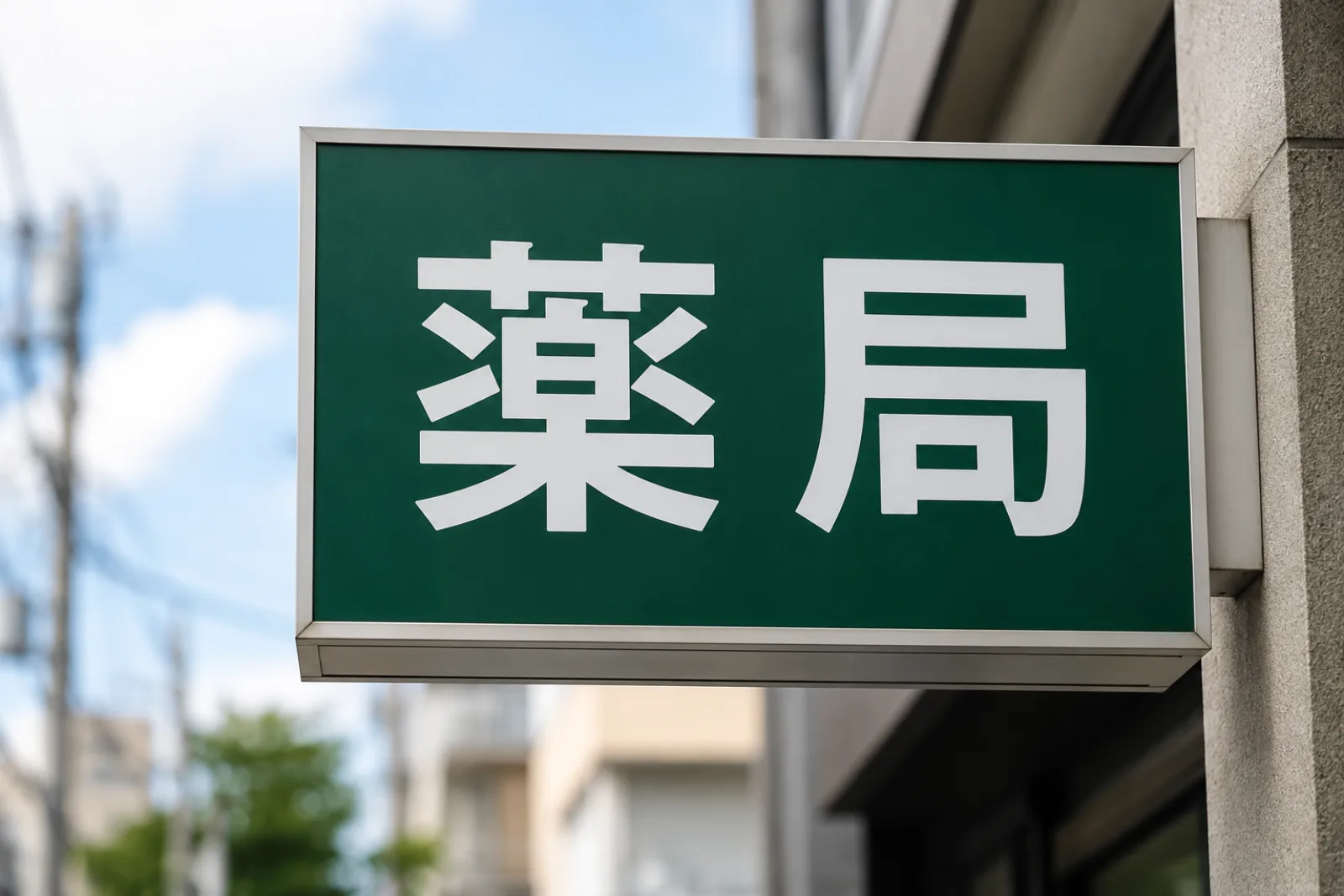
The Tokyo Intercultural Portal Site’s 2023 guide to buying medicine tells patients to take a prescription to a pharmacy counter. Japan Health Policy NOW explains how community pharmacies fit into Japan’s prescription system. Put the two together: read the Japanese sign instead of relying on the store’s English description.
| What you see | What it tells you |
|---|---|
薬局 (yakkyoku) | Pharmacy |
調剤 (chōzai) | Prescription service |
ドラッグストア (doraggu sutoa) | Retail drugstore; prescription service is not guaranteed |
For an over-the-counter product, a drugstore may be enough. With a prescription, check the sign for 薬局 or 調剤 before waiting at the counter.
Why can’t a staff member sell me this over-the-counter medicine?
An open store does not mean every member of staff can sell every medicine. The seller depends on the product’s risk class. Only a pharmacist may sell Drugs Requiring Guidance, the official name for products that require face-to-face guidance, or Class 1 medicines.
A worker with the 登録販売者 qualification may sell Designated Class 2, Class 2, and Class 3 medicines. This person is not a pharmacist and cannot sell Drugs Requiring Guidance or Class 1 medicines. The PMDA’s Regulation of OTC Drugs in Japan, accessed July 28, 2026, gives the following rules:
| OTC category | Who may sell it |
|---|---|
| Drugs Requiring Guidance | Pharmacist only |
| Class 1 | Pharmacist only |
| Designated Class 2 | Pharmacist or a worker qualified as 登録販売者 |
| Class 2 | Pharmacist or a worker qualified as 登録販売者 |
| Class 3 | Pharmacist or a worker qualified as 登録販売者 |
So you may be sent to another counter or asked to wait. Sometimes you will be told to return later even while the store remains open, because the person qualified to sell that category of medicine may not be there at that moment.
Will pharmacists in Japan speak English?
Plan for a pharmacy visit without English. A peer-reviewed study of responding pharmacies in two Kansai areas found that fewer than half offered English through any single support channel the researchers measured.
The study by Suzuki and colleagues was published online on January 16, 2025, using survey responses collected in September and October 2022. Researchers received responses from 46 of 149 pharmacies in Hirakata and 29 of 58 in Suma, a ward of Kobe.
Among those respondents, 47.8% in Hirakata (22 of 46) and 55.2% in Suma (16 of 29) encountered people who did not speak Japanese as a first language at least once a month. English was the most common foreign-language support. Yet fewer than half of respondents offered it through any individual channel: websites, patient forms, medicine bags, information materials, or staff language skills.
The findings do not represent every pharmacy in Japan. They are enough reason to have a translation method ready before you enter instead of assuming someone on duty will speak English.
Practice the pharmacy-counter exchange below.
What questions might I hear at a Japanese pharmacy counter?
Your symptoms may not be the first topic. Staff may ask whether this is your first visit, hand you a questionnaire, ask about your insurance card, or tell you where to wait.
The four lines below come from a bilingual reception guide for Japanese pharmacy staff, published by Mitsubishi Tanabe Pharma on March 30, 2016. These are phrases a staff member may say, not Japanese lines for you to use.
| What a staff member may say | Japanese |
|---|---|
| “Is this your first visit to this pharmacy?” | この調剤薬局は初めてですか? |
| “Please fill out this questionnaire.” | この問診票に必要なことを記入してください。 |
| “Do you have your health insurance card with you?” | 健康保険証をお持ちですか? |
| “Please wait here until your name is called.” | お名前が呼ばれるまで、こちらでお待ちください。 |
On a first visit, the conversation can move straight to a written form. If a staff member speaks and then points to a paper, the immediate problem may be the questionnaire, not your spoken explanation.
What is a monshinhyō, and can I get one in English?
A 問診票 (monshinhyō) is a written medical questionnaire. You can prepare an English version before your trip, but do not assume that every pharmacy keeps one at the counter.
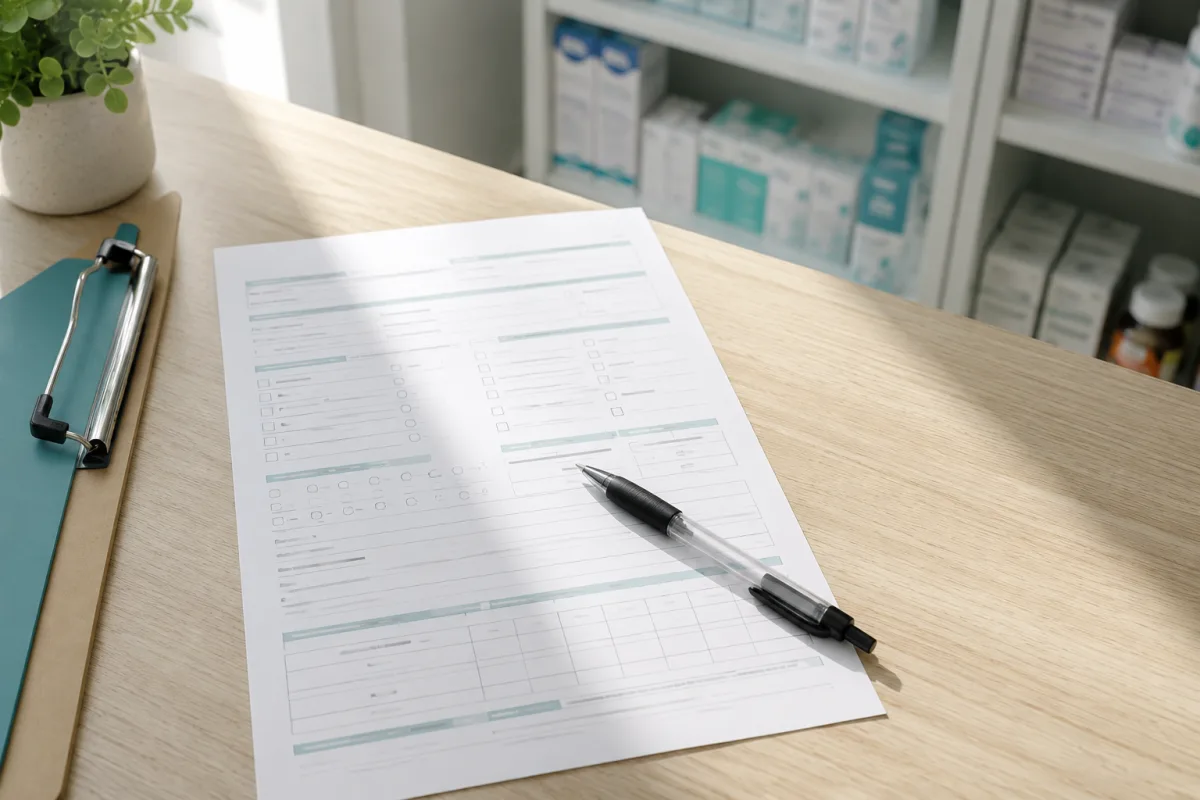
The Multilingual Medical Questionnaire project from the Kanagawa International Foundation and International Community Hearty Konandai provides forms in 23 languages, including English, as checked on July 28, 2026. It distributes the materials to medical facilities, including pharmacies, and lets travelers download and print a relevant form.
The project does not claim that its forms are made specifically for every pharmacy. The Nishiyodogawa Ward Pharmacists’ Association questionnaire page also shows that at least one pharmacy organization publishes its own multilingual patient forms.
Open the form before leaving home and make sure it covers the information you need to provide. If a Japanese paper form becomes the obstacle at the counter, you can show the English version.
What is an okusuri techō, and do tourists need one?
An お薬手帳 (okusuri techō) is an optional record of the medicines you currently take and your treatment history. You do not need to get one just because you are visiting Japan. You should, however, have the names of your current medicines ready for the counter conversation.
The Tokyo Intercultural Portal Site’s 2023 medicine guide describes the record as optional and explains its purpose. If a staff member refers to an okusuri techō and you do not have one, you can provide the relevant medication names yourself.
Keep those names somewhere you can reach without searching through your luggage or phone history. The booklet is optional; the information in it may still matter during the conversation.
How can I practice a Japanese pharmacy conversation before I go?
Start with the staff-side phrases below, then use the live translator to answer in your own words in English. There is no need to invent or memorize Japanese medical sentences for your side of the conversation.
You are likely to hear these four phrases at the counter. They are taken exactly from Mitsubishi Tanabe Pharma’s 2016 bilingual guide for pharmacy staff:
この調剤薬局は初めてですか?means “Is this your first visit to this pharmacy?”この問診票に必要なことを記入してください。means “Please fill out this questionnaire.”健康保険証をお持ちですか?means “Do you have your health insurance card with you?”お名前が呼ばれるまで、こちらでお待ちください。means “Please wait here until your name is called.”
Say what you need in English. The translator carries your reply across the counter in Japanese.
Use it to practice the Japanese pharmacy exchange.
The saved phrases cover what a staff member may say. For the other direction, the translator lets you explain your own situation instead of choosing a prewritten Japanese medical phrase.
Get PhraseBook access updates by email.
What should I know before I walk up to the pharmacy counter?
Before joining the queue, check the sign, expect a short intake process, and get your translation method ready. Store procedures vary, so check these points before you reach the counter.
Can I rely on English at a Japanese pharmacy?
No. The 2022 survey of responding pharmacies in Hirakata and Suma found limited English support across the individual channels it measured. The study does not represent all of Japan, but it gives you no reason to rely on English.
Can any drugstore fill a prescription?
No. A drugstore may or may not fill prescriptions. Look for 調剤 or 薬局 rather than relying on the word “drugstore.”
Why am I being asked to wait for a pharmacist?
Drugs Requiring Guidance and Class 1 over-the-counter medicines may only be sold by a pharmacist under the PMDA seller rules. The store may be open while the person qualified to sell that medicine is unavailable.
Can I ask for an English questionnaire?
Yes, but do not assume the pharmacy has one ready. The Multilingual Medical Questionnaire project offers forms in 23 languages, including English, that you can download before your trip.
Do I need an okusuri techō as a tourist?
No. The medicine record is optional, but prepare the names of the medicines you currently take so you can provide the information it would contain.
Try the translator above, then leave your email for PhraseBook access updates.
Updated: July 28, 2026