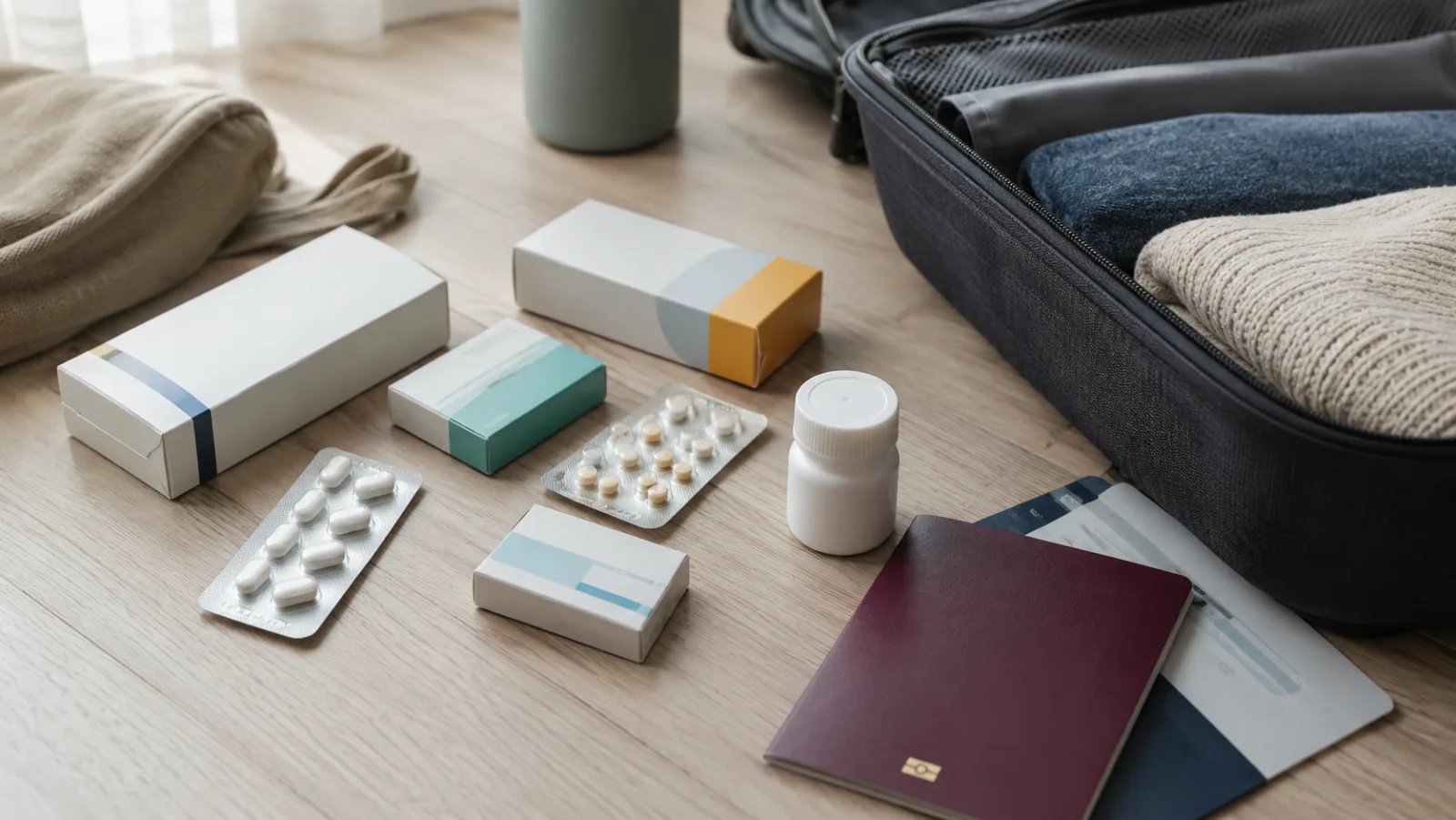
What Medicines Can’t You Bring Into Japan? A Guide for Travelers With Prescriptions
A prescription from your home country does not by itself make a medicine legal to bring into Japan. Some active ingredients are prohibited outright, some require advance permission, and others may be brought only within quantities set by Japanese rules or by an issued permission — not by the amount written on your prescription.
Before you travel, check your medicine's active ingredient against current guidance from Japan's Ministry of Health, Labour and Welfare (MHLW) and its Narcotics Control Department (NCD). If your route requires NCD permission or MHLW Import Confirmation, obtain that specific document before departure and carry it with the medicine and its supporting paperwork.
How do I check whether my medicine is allowed in Japan?
Start with the active ingredient. The name on the box is not enough. The NCD groups controlled substances by ingredient and category, so searching by brand name alone can miss the rule that applies.
- Find the active ingredient and strength on the packaging, dispensing label, or prescription.
- Compare the ingredient with the current NCD Application Guidance and Controlled Substances List.
- Follow the official route for that category. A prescribing doctor can help identify the active ingredient, strength, and formulation. A doctor does not determine whether Japan allows you to import the medicine. For a question about a controlled substance or NCD permission, contact the NCD office responsible for your airport of entry using the offices listed in the current NCD guidance. For the general personal-import route or Import Confirmation, use the contacts and application route on the MHLW personal-import page. There is no single office named in these sources that decides every medicine category. If you cannot establish which route applies, ask the relevant NCD office and MHLW through those official channels before you travel.
Official pages can change, and the same brand may have different formulations in different countries. The absence of an ingredient from the NCD Controlled Substances List does not mean that Japan permits it. The list is not a list of approved medicines; separate MHLW rules, ingredient restrictions, and quantity limits may still apply. Use this article to reach the primary sources. Do not treat it as a permanent list of approved brands.
Check the active ingredient in Japan’s official controlled-substances guidance.
What does the NCD list under Prohibited Substances?
The NCD’s current Prohibited Substances section says:
No individual travelers can import/export medicines including the following substances, even if they are prescribed medicines in your country;
・Heroin
・Opium powder
・Methamphetamine and Amphetamine(INN:Dexamphetamine, Levamfetamine)
・Methaqualone
This is the NCD’s wording in the section checked on July 29, 2026. Do not bring a medicine containing a substance covered by that section: an application, foreign prescription, doctor’s letter, or Import Confirmation cannot change its status. This is not a complete list of every restricted medicine, brand, or ingredient in Japan; other restrictions exist outside this NCD section.
MHLW also publishes a separate rule for products that meet both conditions at the same time: the product contains a designated pharmaceutical ingredient from MHLW’s separate list, and it is sold abroad with claims of “enhancing cerebral function and other mental effects.” Both conditions must be present for this rule to apply. MHLW’s wording includes an exception connected to use in accordance with a doctor’s prescription, but a prescription alone does not establish that the product may be imported. The product must still comply with every applicable NCD prohibition or permission requirement, as well as MHLW’s other personal-import rules and quantity limits. Check the MHLW personal-import guidance and the separate current ingredient table.
Can I bring Adderall or Vyvanse to Japan?
You cannot bring Adderall into Japan, even for treatment. Adderall is a mixture of amphetamine salts, including dextroamphetamine; the NCD’s prohibited-substances wording above identifies “Amphetamine(INN:Dexamphetamine, Levamfetamine).” In its Adderall FAQ, the NCD states: Amphetamine, Active Pharmaceutical Ingredient (API) of ADDERALL, is controlled as "Stimulants" under the Stimulants Control Act, and cannot be imported into Japan, even for treatment purposes.
The NCD gives a different answer for Vyvanse: lisdexamfetamine is classified as Stimulants’ Raw Materials, so you must obtain NCD permission before bringing it into Japan. Permission is not guaranteed and may be refused. Without issued advance permission, you cannot bring Vyvanse into Japan.
| Medicine | Active ingredient named by the NCD | Rule | Next step |
|---|---|---|---|
| Adderall | The NCD identifies its API as Amphetamine; Adderall contains mixed amphetamine salts, including dextroamphetamine | Cannot be imported, even for treatment | Do not bring it; discuss your travel plan with the prescribing doctor |
| Vyvanse | Lisdexamfetamine | Classified as Stimulants’ Raw Materials; issued advance permission is required, and approval is not guaranteed | Apply to the responsible NCD office early enough to receive permission before travel; do not bring it without the issued permission |
The distinction comes from the NCD’s official Adderall and Vyvanse FAQ answers, checked July 29, 2026. It does not establish a rule for any other ADHD medicine or brand.
Which prescription medicines need permission before I travel?
Narcotics and Stimulants’ Raw Materials require advance NCD permission. Psychotropics follow a separate threshold rule, while other prescription medicines may fall under MHLW’s general personal-import limit if no stricter category applies.
| Category | Examples named by the NCD | What the cited rule requires | Where to check |
|---|---|---|---|
| Prohibited Substances | Heroin; opium powder; methamphetamine and amphetamine; methaqualone | Import by an individual traveler is not allowed | NCD prohibited-substances section |
| Narcotics / Stimulants’ Raw Materials | Morphine, fentanyl, oxycodone, codeine, GHB, lisdexamfetamine | Advance NCD permission | NCD application section |
| Psychotropics within the official threshold, in a non-injectable form | Methylphenidate, zolpidem, alprazolam, diazepam | No advance permission under the cited NCD rule; check the ingredient and quantity against the current official table | NCD psychotropics table and guidance |
| Other prescription drugs within the general limit | No examples added here | No Import Confirmation for up to one month’s supply, unless a stricter rule applies | MHLW personal-import guidance, checked July 29, 2026 |
For a psychotropic above its listed threshold, or in injectable form, the NCD guidance requires a medical certificate. Do not use this table to infer the status of a medicine that is not named: check its active ingredient and the current threshold table.
How much medicine can I bring without Import Confirmation?
MHLW allows certain personal-use quantities without Import Confirmation, but the amount depends on the product type. These general limits never make a prohibited substance legal and do not replace NCD permission for a controlled substance.
The wording below follows the English MHLW personal-import page, checked July 29, 2026:
| Type | General amount without Import Confirmation | Important condition |
|---|---|---|
| Poison, Deadly poison, Prescription drug | Up to 1 month supply | A stricter prohibited- or controlled-substance rule still takes priority |
| Drug for external use | Up to 24 per one item | Excludes Poison, Deadly poison, and Prescription drug |
| Injectable drug and syringe for the drug | Up to 1 month supply | Only a “Pre-filled Syringe” or “Self-injection Kit” |
| Other Drugs, Quasi drugs | Up to 2 month supply | A stricter ingredient rule still takes priority |
| Cosmetics | Up to 24 per one item | The limit applies to each item |
The number 24 applies only to external-use products that meet the stated exclusions and to cosmetics. It means 24 units for each product name; it is not a limit for tablets or prescription medicines.
If you exceed the applicable amount, MHLW says you must apply for MHLW Import Confirmation (Yunyu Kakunin-sho), receive that document before departing for Japan, and carry it with the medicine to show the customs officer. A doctor’s letter is supporting medical documentation, not Import Confirmation. The next step is to identify which of the two application routes applies to your medicine.
Do I need NCD permission or a Yunyu Kakunin-sho?
NCD permission and a Yunyu Kakunin-sho are different documents for different rules. NCD handles advance permission for Narcotics and Stimulants’ Raw Materials, while MHLW’s Import Confirmation covers the general personal-import route, including quantities above its no-application limits.
| Procedure | When it applies | Responsible office | Application route | What it cannot do |
|---|---|---|---|---|
| NCD permission | Narcotics or Stimulants’ Raw Materials | The NCD office responsible for your airport of entry | NCD Application Guidance | It cannot authorize a substance in the current Prohibited Substances section |
Yunyu Kakunin-sho / Import Confirmation | The MHLW personal-import route, including an amount above the general limit | MHLW through the relevant pharmaceutical-import procedure | MHLW online application | It cannot legalize amphetamine or another substance prohibited by the NCD |
You may see the older name Yakkan Shoumei in travel advice and older instructions. The current MHLW term is Yunyu Kakunin-sho, translated as Import Confirmation.
How do I apply before bringing prescription medicine to Japan?
Choose the application route based on the medicine’s category. Controlled substances that require NCD permission go to the NCD office for your airport of entry. Import Confirmation uses a separate MHLW online system.
What do I need for NCD permission?
The NCD Application Guidance, checked July 29, 2026, requires an application form, a medical certificate, and photographs of the medicine’s packaging. The medical certificate must state the specific medical reason and list the medicines. It must have been issued within the previous three months.
Send the application to the NCD office responsible for the airport where you will enter Japan. Use the office details on the current guidance page rather than treating one email address as a nationwide contact.
Where do I apply for a Yunyu Kakunin-sho online?
Use the official MHLW Import Confirmation application system. MHLW also publishes current system manuals. Check those manuals instead of relying on a saved walkthrough because the interface and required fields can change.
Open the official application route for your category:
- For a controlled substance, use the NCD Application Guidance.
- For Import Confirmation, use the MHLW online application.
Neither agency promises an approval time, and neither document can reverse a prohibition.
How early should I apply for permission?
Start at least four weeks before you travel, then confirm the current timing with the office handling your procedure. NCD permission and Import Confirmation follow separate routes and have different timing guidance. Four weeks is a planning margin, not a guarantee of approval.
For NCD permission, the official NCD guidance, checked July 29, 2026, says to submit the required documents at least 14 days before travel. This is the agency’s stated minimum for its controlled-substance procedure, not a general promise for every medicine application.
For Import Confirmation, the institutional Japan travel guidance accessed July 28, 2026 advises allowing up to four weeks. Begin that route at least four weeks ahead and check the current instructions in the MHLW application system.
Can I bring Sudafed or other pseudoephedrine products to Japan?
Do not assume that Sudafed or another pseudoephedrine product is allowed because you can buy it over the counter at home. Formulations vary by country. The sources checked for this article do not support one rule for every product sold under a particular brand name.
The NCD guidance places pseudoephedrine within the rules for Stimulants’ Raw Materials. The MHLW personal-import page checked on July 29, 2026 does not mention pseudoephedrine at all. For that reason, this article does not publish the often-repeated percentage threshold or try to decide a product’s status from its brand.
Leave the product at home unless the responsible Japanese authority gives you current written confirmation for its exact active ingredient, concentration, quantity, and formulation. For an ordinary travel need, ask a pharmacy in Japan about a locally available option; this guide explains how to ask at the counter without speaking Japanese.
What should I do if my medication is prohibited?
Do not bring a prohibited medicine or assume that a prescription, doctor’s letter, or Import Confirmation will create an exception. Contact the doctor who prescribed it before your trip, explain the Japanese restriction, and discuss whether there is a treatment option whose active ingredient can legally enter Japan.
Check any proposed ingredient against the current NCD guidance, then confirm its category and procedure with the responsible Japanese office. Do not stop, replace, or change the dose of a medicine on the basis of this article; those are medical decisions for the prescribing clinician.
If there is no suitable lawful plan before departure, change the travel or treatment plan with the relevant professionals. Do not pack the medicine “at your own risk,” and do not assume that an equivalent product will be available in Japan.
What should I verify before I fly with medicine to Japan?
Recheck every medicine against the primary sources shortly before you pack. This checklist can catch paperwork mistakes, but it does not guarantee that a product will be admitted at the border.
- Write down the active ingredient, strength, formulation, and quantity.
- Confirm the ingredient’s current NCD category.
- Check whether you need NCD permission, Import Confirmation, or neither under the cited rule.
- Confirm that your documents match the current requirements.
- Use the NCD office responsible for your airport of entry.
- Recheck the current processing guidance and leave time for questions.
- Carry the issued NCD permission or MHLW Import Confirmation, if required, with the medicine and supporting medical documents for customs.
Is Yakkan Shoumei the same as Yunyu Kakunin-sho?
Yakkan Shoumei is the older name that still appears in travel information. Yunyu Kakunin-sho, or Import Confirmation, is the current term used for the MHLW personal-import document.
Which Japanese office should I contact?
For NCD permission, contact the NCD office responsible for your airport of entry; the current NCD guidance lists the route and offices. For Import Confirmation, use the contacts and application route linked from the MHLW personal-import page.
What should I show at customs?
If your route requires MHLW Import Confirmation, receive the issued Yunyu Kakunin-sho before departing for Japan and carry it with the medicine to show the customs officer. For a medicine covered by NCD permission, carry the issued permission with the medicine and the prescription or medical documentation required by the current NCD guidance; recheck the exact document set before departure.
Recheck the official MHLW personal-import guidance and NCD Application Guidance before you pack.
Updated: July 29, 2026